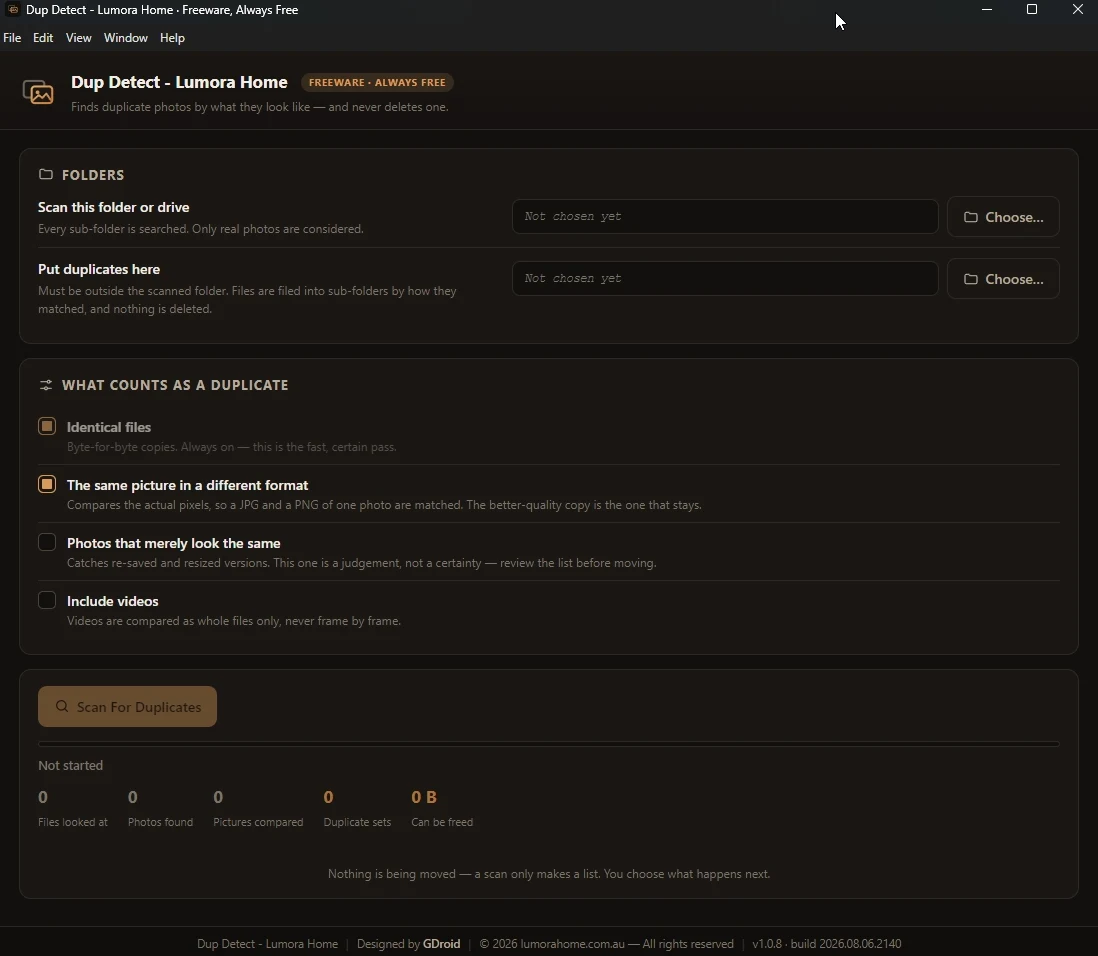
Five passes, cheapest first, each one narrowing what the next has to look at. That ordering is what lets a whole-drive scan finish in reasonable time: the expensive tests only ever run on the handful of files that survived the cheap ones.
The passes do not each report their own findings. They contribute evidence to a single grouping that is merged as they go. This matters in a case that comes up constantly:
a.jpg and b.jpg are byte-identical. c.png is the same picture, saved losslessly.
Handled pass by pass, the two JPEGs would pair off in pass 3 and — being "already resolved" — never reach pass 4, so the PNG would never be connected to them and the answer would quietly omit the best copy. Here all three come back as one set, and the PNG is the keeper.
The expensive passes decode one file per set and share what they learn with the rest of it, so decoding cost tracks the number of distinct pictures rather than the number of copies.
If a group is held together partly by a perceptual guess, it is shown as a guess — never as a certainty — even if some of its members are byte-identical to each other.